When AI Enters Finance: From Wall Street to Main Street
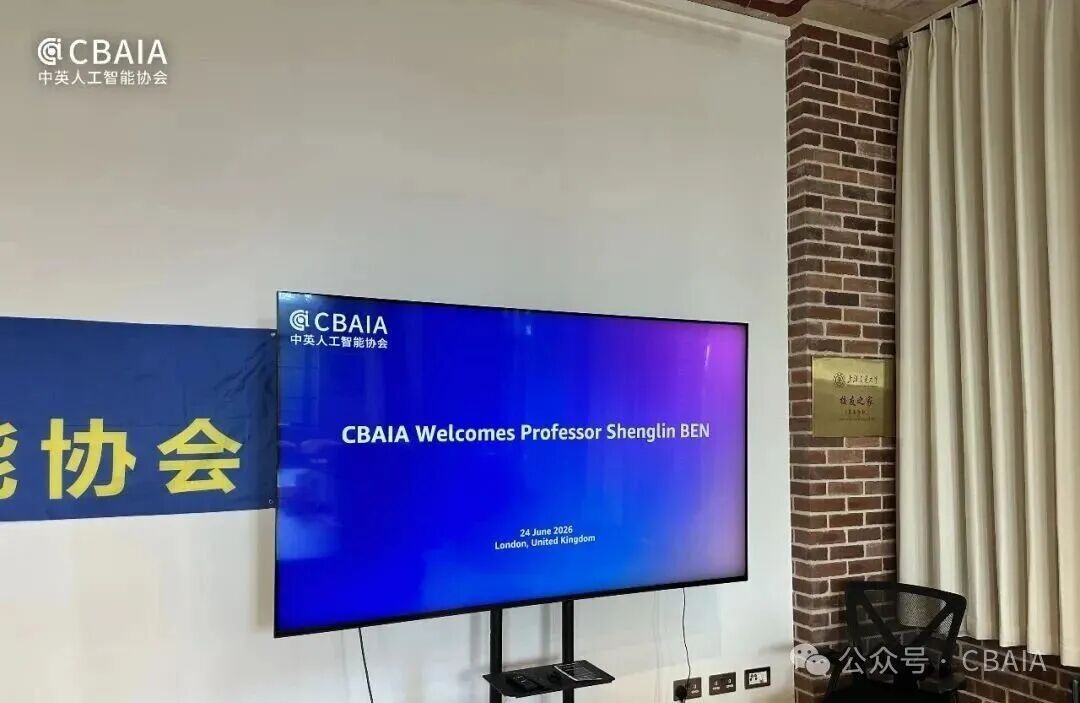
On 24 June 2026, the China-Britain Artificial Intelligence Association (CBAIA) had the pleasure of inviting Professor Ben, Dean of Zhejiang University International Business School (ZIBS), to an in-depth closed-door discussion with CBAIA Club members, core members of the Association, and guests from the fields of finance, technology, education and innovation.
From the artificial intelligence industry chain to different paths of fintech development; from the UK’s innovation environment to the competitive strengths of banks; and from green finance and digital finance to retirement and cross-border finance—the discussion spanned multiple fields, but remained centred on one fundamental question:
Technology continues to advance and finance continues to innovate, but whom do these advances ultimately serve?
Do they serve Wall Street, represented by a small number of large institutions and professional investors, or can they genuinely reach Main Street, represented by ordinary households, small and medium-sized enterprises, and the real economy? This was also the question raised during the discussion that most merits continued reflection.
Understanding AI: Looking Beyond Models to the Full Industry Chain
When discussing artificial intelligence, people often think first of large models. Professor Ben argued, however, that understanding the development of AI requires placing it within the context of the complete industry chain.
Upstream are foundational elements such as data, cloud infrastructure, computing power and chips; the midstream consists of general-purpose and industry-specific models; and downstream are the practical applications of AI in finance, education, healthcare, industry, intelligent office systems and consumer devices. Different countries possess different strengths.
For example, the United States has strong foundational technologies, computing resources and leading technology companies. Its development model is often characterised by large-scale investment and leadership from major institutions. China, meanwhile, has a vast market, a rich variety of industry scenarios and strong application capabilities. In lightweight models, vertical industry models and product applications aimed at broad user groups in particular, it is easier to establish a more inclusive technological path.
This means that a country’s AI capabilities cannot be measured solely by the number of leading models it possesses. It is also necessary to consider whether these models can enter real-world settings, solve real problems and be used by more people. AI with genuine vitality exists not only in laboratories and rankings, but also in factories, banks, schools, offices and the everyday lives of ordinary people.

Professor Ben, Dean of Zhejiang University International Business School (ZIBS), shares his insights with attendees
The TIGER Framework for AI and Finance
In considering the future development of finance, the discussion produced a highly thought-provoking framework: TIGER.
T: Technology—Technology Finance
The first question that technology finance must answer is: can finance genuinely support innovation?
AI companies, hard-technology enterprises and early-stage start-ups typically have long investment cycles, high levels of risk and few conventional assets to offer as collateral. If the financial system remains adept only at serving mature companies with stable cash flows, many projects with genuine innovative value will struggle to secure support. Technology finance therefore means not only that banks adopt more technology, but also that financial capital, venture capital and long-term funding can serve technological innovation more effectively. The integration of AI and finance should not remain limited to intelligent customer service, automated reports or cost reduction. The deeper change is that AI is beginning to enter risk control, research, compliance, customer service and business decision-making processes, reshaping how financial institutions are organised.
I: Inclusive—Inclusive Finance
Inclusive finance reflects the accessibility of finance as well as its people-centred nature. Even in the world’s most developed financial centres, modern financial systems and traditional payment methods may continue to exist side by side. On one side are highly complex capital markets, quantitative trading and digital assets; on the other, some small merchants and ordinary people still rely on cash, cheques or relatively expensive basic financial services.
This reminds us that whether a financial system is advanced cannot be judged solely by the complexity of its capital markets. We must also consider whether ordinary people can obtain safe, convenient and dignified financial services at a sufficiently low cost. From bank card networks and mobile payments to low-threshold accounts and inclusive credit, payment systems are not only commercial products; they are increasingly taking on the characteristics of public infrastructure. The development of payment systems such as India’s UPI and Brazil’s Pix also demonstrates that when governments, financial institutions and technology companies participate jointly in infrastructure development, digital finance can serve society more broadly rather than being monopolised by a small number of platforms.
G: Green—Green Finance
Green finance is not merely an investment label. It also concerns energy structures, industrial transformation and the allocation of responsibilities among different countries. Behind net-zero emissions, electric vehicles, clean energy and investment in green industries are complex practical questions: who should bear the cost of transition? How should responsibilities be divided between developing and developed countries? How should financial institutions identify genuine green value rather than remaining at the level of concepts and packaging?
China has developed significant strengths in both the application and manufacturing of new-energy vehicles and green industry chains, but the green transition still requires longer-term and more patient capital support. The role of finance should not be merely to pursue popular assets, but to help industries achieve genuine structural transformation.
E: E-finance—Digital Finance
Digital finance is not simply about moving offline business online. Genuine digitalisation means redesigning accounts, payments, risk control, services and the customer experience so that information flows, capital flows and business flows can be connected more efficiently.
Traditional banks possess customer bases, licences, compliance capabilities and global networks, while fintech companies are generally more agile in product design, real-time feedback and user experience. Future competition may not involve the straightforward replacement of traditional banks by fintech companies. It is more likely to involve a new combination of infrastructure, data capabilities, technological experience and systems of trust.
R: Retirement—Retirement Finance
As demographic structures change, retirement finance is becoming an increasingly important subject. Retirement is not only a social security issue; it also involves long-term savings, pension management, wealth planning, medical expenditure and intergenerational arrangements. Compared with the pursuit of short-term returns, retirement finance provides a greater test of whether a financial system is genuinely long-term in its outlook: can it design products that are truly suitable for ordinary households, help people navigate different stages of life, and establish an appropriate balance between security, returns and liquidity?
Although the five dimensions of TIGER appear different, they all point towards a common objective: enabling finance to serve technology, society, the environment and people’s long-term lives more effectively.
Wall Street and Main Street: Has Financial Innovation Reached Ordinary People?
“Wall Street” represents large financial institutions, capital markets and professional investors, while “Main Street” represents ordinary consumers, small and medium-sized enterprises, communities and the real economy. For a long time, many financial innovations have emerged first on Wall Street. More advanced trading systems, more complex financial products and more powerful data tools have often served institutions with greater financial resources and stronger professional capabilities as a priority.
But the truly important question is:
When will these innovations reach Main Street?
Can AI make it easier for small businesses to obtain finance? Can it reduce account and payment costs for ordinary people? Can it ensure that financial advice is no longer an exclusive service for high-net-worth clients? Can it help older people, low-income groups and those with limited financial knowledge to manage their lives more effectively? Technology can increase efficiency, but it can also widen disparities. When the most advanced models, data and financial products are controlled by only a small number of institutions, technological progress does not automatically result in social inclusion.
Financial innovation must therefore consider two forms of value at the same time. One is commercial value, which focuses on efficiency, costs, profits and growth. The other is public value, which focuses on fairness, accessibility, trust and social impact. The two are not inherently in conflict. Truly outstanding financial innovation should create commercial value while also giving more people the opportunity to participate in economic life.

William Xu, CFO of CBAIA, exchanges views with Professor Ben
The UK’s Challenge: Finding a Balance Between Regulation, Privacy and Innovation
As an important global financial centre, the UK has a mature legal system, financial institutions, professional talent and international networks. In the age of AI, however, the UK also faces several structural challenges.
The first concerns data and privacy. Strict data protection rules help safeguard individual rights and social trust, but complex and lengthy compliance processes may also increase the cost of innovation and affect the speed of technological trials and commercial implementation. The question is not whether privacy should be protected, but how clearer and more efficient rules for responsible innovation can be established while protecting individual rights.
The second concerns education and talent. AI and digital finance require not only technical specialists, but also multidisciplinary professionals capable of understanding commercial, ethical, social and cross-cultural issues. How schools cultivate students’ ability to ask questions, exercise judgement and develop digital literacy will affect a country’s future capacity for innovation. At the same time, the coordination costs faced by the UK in transport, digital infrastructure and the delivery of public projects demonstrate that innovation depends not only on technology itself, but also on whether institutions can provide long-term, stable and effective implementation.
This led to a deeper question during the discussion:
When some members of society feel that they have been forgotten by technology, globalisation and financial development, do elite institutions truly see them?
Professionals in technology and finance should not focus solely on efficiency and success within their own industries. They must also understand the impact of technological change on ordinary people, communities and social structures. The idea of “taking responsibility for all under heaven” may today mean that those with knowledge, resources and influence also have a responsibility to ensure that innovation does not provide opportunities only for a small minority.
A Bank Should Not Be Assessed Solely by Its Size and Profits
During the discussion, guests also considered the strengths of different types of financial institutions. Large international banks often possess deep experience in global networks, institutional services, regulatory systems and cross-border business. Fintech companies may stand out more in product speed, real-time feedback and the mobile experience. Private banks and wealth management institutions, meanwhile, place greater emphasis on understanding clients, protecting privacy and maintaining long-term relationships. It is therefore difficult to use a single standard to decide which bank is “best”.
The key questions are which clients it serves, which problems it solves and in which area it has developed genuine capabilities. For institutional clients, global networks, capital strength and professional services may be more important. For retail customers, the account-opening experience, convenient payments, real-time notifications and transparent fees may be more critical. A very large bank does not necessarily provide the best user experience, while a smoothly designed financial application does not necessarily possess comprehensive risk management and global service capabilities.
Competition among financial institutions in the future will no longer be based solely on asset size. It will be a comprehensive contest involving technological capabilities, trust, customer connections, infrastructure and cross-border service capabilities.
The Future of AI and Finance Is Not Only About Greater Speed, but Also Clearer Direction
AI is helping financial institutions improve efficiency, reduce costs and reshape business processes. But if we focus only on being “faster”, delivering “more” and becoming “cheaper”, we may overlook more important questions:
- Is finance becoming fairer?
- Is technology genuinely inclusive?
- Has innovation improved the lives of ordinary people?
- Does the financial system support society’s long-term development?
From Technology to Inclusive, and from Green to E-finance and Retirement, the TIGER framework reminds us that the true value of AI and finance lies not only in creating new products and business models, but also in reconsidering the role of finance in society. Moving from Wall Street to Main Street does not mean rejecting the value of capital markets or large financial institutions. Rather, it gives financial innovation a broader frame of reference. Technology should serve real needs, capital should support long-term value, and finance should create not only wealth but also opportunities, trust and connections. This may be the direction towards which AI and finance should strive.
As the first formally appointed adviser to the China-Britain Artificial Intelligence Association (CBAIA), Professor Ben has provided major support and assistance throughout CBAIA’s development over the past eight years. A small but warm CBAIA badge presentation ceremony was therefore arranged during the event, at which the Association presented Professor Ben with a CBAIA badge and pinned it on him. With the guidance of Professor Ben and the Association’s other senior advisers, we have every confidence and look forward with great anticipation to the next eight years.
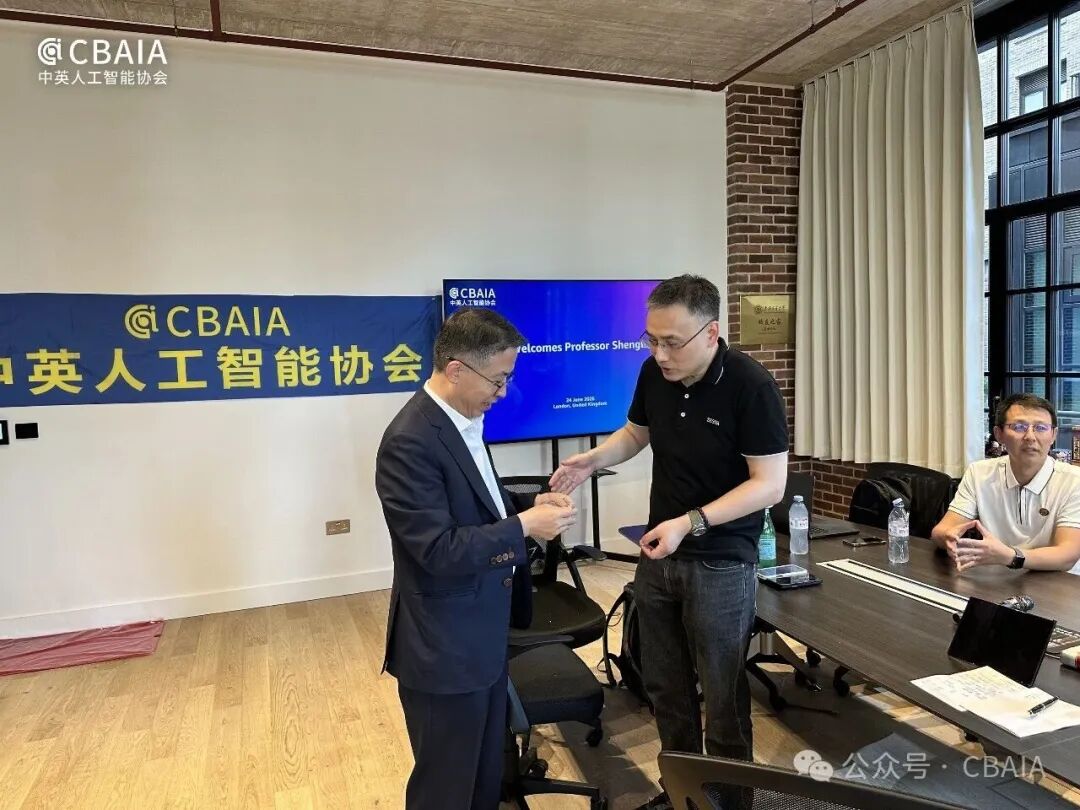
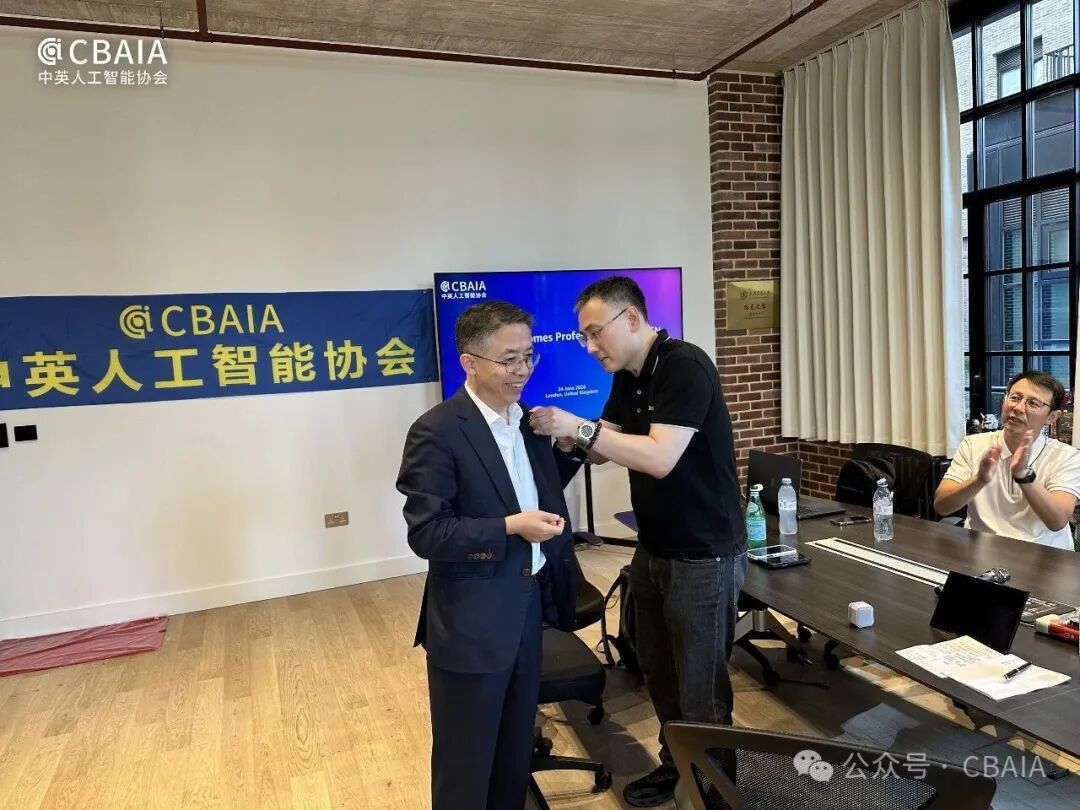
The Association presented Professor Ben with a CBAIA badge and pinned it on him
Special thanks go to Professor Ben of Zhejiang University International Business School for his excellent presentation, as well as to all the guests who participated in this closed-door discussion.
The value of ideas lies not only in providing answers, but also in raising questions worthy of long-term consideration. CBAIA looks forward to continuing to connect the artificial intelligence, finance and innovation ecosystems of China and the UK, and to promoting more cross-sector dialogue with professional depth, commercial value and social significance. From technology to application, and from discussion to action, we aim to help innovation achieve real-world implementation and reach more people.


Attendees with Professor Ben after the event
Planning | Tengfei Yin, Zhenhai Li
Delivery | Qiuyue Zhang, Tengfei Yin, Zhenhai Li
Host | Zhenhai Li
Photography | Lu Ni, Tengfei Yin
Author | Lu Ni
Editor | Tengfei Yin
Reviewer | Zhenhai Li